John's Desk
My Philosophy
Every business challenge eventually becomes a people challenge. The right hire can accelerate growth. The wrong leader can stall it.
Great employees don't stay by accident, and strong teams aren't built through luck. Better businesses are built one people decision at a time.
Cornerstone Lessons
Thoughts Worth Challenging
Thirty years of hiring, leadership, and advising business owners has taught me that some of the most common assumptions about people and business deserve to be questioned. You may agree with these. You may not. Either way, they're worth thinking about.
-
01
That position you're waiting to fill is costing your business more than you think.
Open roles don't just create extra work. They impact customers, morale, growth, and your bottom line.
-
02
Post and pray isn't a hiring strategy.
Hoping the right person applies is not the same as having a plan to attract, evaluate, and hire great talent.
-
03
Your culture isn't what you say it is. It's what your employees say it is.
Mission statements don't define culture. Everyday experiences do.
-
04
Your people decisions affect far more than your employees.
They shape customer experience, profitability, growth, reputation, and the future of your business.
-
05
Not every people problem requires another hire.
Sometimes the answer is better leadership, clearer expectations, coaching, restructuring, or an honest conversation.
-
06
The hardest people conversation is usually the one your business needs most.
Avoiding difficult conversations rarely protects a business. It usually delays a bigger problem.
-
07
AI isn't the answer to your business problems. It's the beginning of new ones.
Companies that replace people with technology without thinking through the human impact will create challenges they never expected.
-
08
Better people decisions build better businesses.
Every hire, promotion, difficult conversation, leadership decision, and culture choice shapes the future of your company.
21 Questions to Ask Before You Hire
A practical pre-hire checklist to help you slow down, ask the right questions, and avoid a costly mis-hire.
DownloadAI Is Moving Faster Than Your Managers
Three recent stories, one leadership problem: why AI adoption is a people decision before it's a technology decision.
DownloadThe True Cost of an Open Position
A rough estimate of what an unfilled role is really costing you, beyond the obvious.
Paid hourly? Multiply the hourly rate by 2,080 (a standard full-time year) to get the annual figure to enter here.
- Role impact $0
- Team strain and lost opportunity $0
- Interview time $0
Role impact is the role's weekly salary times weeks open. Team strain and lost opportunity adds half that again, the extra cost of the team covering the gap. A starting point for the conversation, not an exact figure.
Let's Talk About This RoleField Notes
Stories From The Desk
How long is too long?
I've watched companies leave a role open for months. Weeks turn into a full quarter. Sometimes longer. And the whole time, leadership says the same thing in the all-hands: “We're focused on growth.” But nobody on the team is buying it anymore.
Because they're the ones covering the gap.
They're the ones answering emails that used to go to someone else. Sitting in meetings that used to have another seat filled. Picking up the slack that was never supposed to be theirs to carry.
And it's quiet at first. Nobody complains out loud.
They just get a little more tired. A little more short. A little less likely to stay late for something that actually matters, because they've been staying late for something that shouldn't have been theirs in the first place.
Here's the thing leadership misses.
An open role isn't neutral. It isn't a pause button. It isn't free.
It's a tax. And someone is always paying it.
Maybe it's the team's morale. Maybe it's the quality of the work. Maybe it's the customer on the other end of a slower response time, wondering why things feel a little less sharp than they used to.
Whatever it is, something is always absorbing the cost of that empty chair.
And here's what really gets me.
The math almost never works out the way they think it does.
They save the salary line. That part's real.
But they lose it somewhere else. In turnover, because the good ones eventually get tired of doing two jobs for one paycheck. In slower execution, because a stretched team makes more mistakes and moves more cautiously. In the quiet erosion of trust, because every week that seat stays empty is another week the team hears “we care about you” and watches the opposite play out in real time.
You can't say people are your priority and then treat their bandwidth like it's infinite.
Actions are the only language people actually believe.
And an empty seat, left open for the sake of a spreadsheet, speaks louder than any deck slide about culture ever will.
I get it. Hiring is expensive. Hiring the wrong person is worse. Nobody wants to rush a decision that's hard to undo.
But there's a difference between being thoughtful and being negligent. Between taking the time to find the right fit and taking the time because it's convenient for the budget.
One is leadership. The other is just cost-cutting wearing a leadership costume.
And teams know the difference. They always do.
They can feel when a company is being careful. And they can feel when a company is just being cheap and hoping nobody notices.
So how long is too long?
I don't think there's a universal number. Six weeks might be fine for one team and brutal for another, depending on what's actually being asked of the people left standing.
But I think you know it when you see it. When the team stops asking “when are we filling this?” and starts just quietly adjusting to a smaller version of what they used to be. When “temporary” stops meaning temporary and starts meaning permanent, just without the announcement.
That's the line. Not a date on a calendar. A shift in how the team talks about the gap.
Once they stop expecting it to close, you've already lost more than the money you were trying to save.
Growth doesn't run on empty seats. It runs on people who still believe the company will show up for them the way it's asking them to show up for the company.
So if you're the one holding that decision, ask yourself honestly:
Is this role still open because you're being careful?
Or because it's easier not to look at what leaving it open is actually costing you?
The Car Accident
That gap on the resume. Eleven months. You saw it before you saw anything else. Your eyes went straight to it, and something in your gut said pass. Too risky. Too many questions. Too hard to explain to the team why you brought in someone who hasn't worked in almost a year.
So you moved on to the next resume. Clean. Continuous. No red flags.
Here's what you didn't know.
That guy you skipped ran his own company for eight years. Doing exactly what you need done. Built it from nothing, made payroll, made decisions, made mistakes and fixed them, because that's what owning something forces you to do.
Then a car accident put him in a bed for months.
Not a vacation. Not a mental break he needed to explain away. A body that stopped working the way it used to, and a life that got rearranged around recovery instead of revenue.
And you never asked.
You just saw the gap and made the call.
Here's the thing about resumes. They're built to reward continuity, not capability. They reward the person who never had to stop, never got sick, never had a kid who needed them, never had a parent who was dying, never had a body that betrayed them at the worst possible time.
They don't reward resilience. They punish disruption.
And disruption isn't the same thing as failure.
Sometimes the person with the gap is the one who's already been tested in ways your other candidates haven't. They've already had to sit with uncertainty. Already had to rebuild something from a place of not knowing if it would come back together.
That's not a weakness on paper. That's a person who knows what it costs to keep going when going is the hard choice.
But you'll never see any of that if the gap is where your evaluation stops.
I think about how many good people get filtered out before anyone even talks to them. Not because they lacked the skill. Not because they lacked the drive. But because a line on a page didn't match the shape you were looking for.
And the ones who make it through? Sometimes they're just the ones whose lives happened to stay tidy enough to fit your filter.
That's not the same thing as finding the best person.
That's finding the person whose story was easiest to read at a glance.
So here's the question worth sitting with.
Are you hiring for a résumé that looks safe? Or are you hiring for a person who can actually do the work?
Because those aren't always the same thing. And the gap that made you nervous might be the exact experience that makes someone better at the job than anyone else in your stack of applications.
You don't have to hire every person with a gap. That's not the point.
But you owe it to yourself, and to the business, to ask why before you decide it disqualifies them.
Pick up the phone. Ask the question you're afraid might have a complicated answer.
Because the story behind that gap might be the very thing that tells you everything you need to know about how they handle hard things.
And isn't that exactly what you're hiring for?
You Don't Suck At Hiring
I've said that to more than one business owner, and every time, they look at me like I'm about to let them off the hook. I'm not. Because the problem usually isn't who you hired. It's what happened after.
You brought in good people. Then you handed them a laptop, a login, and a vague sense that someone would check in eventually.
That's not a system. That's hope wearing a lanyard.
And hope doesn't scale.
Here's what I see over and over. A leader hires someone talented, someone who interviewed well, someone who seemed like exactly the right fit. Then three months later that same leader is frustrated, wondering what happened. Wondering if they made a mistake.
They didn't make a mistake in the hire.
They made a mistake in what came next.
Because accountability isn't a one-time conversation you have during onboarding week. It's not a performance review that happens once a year, long after the moment it could've actually helped anyone.
It's ongoing. It's weekly. Sometimes it's daily, depending on the role.
And it gets so much harder when your team isn't sitting ten feet away from you.
In an office, accountability sort of happens by accident. You walk by a desk. You catch a conversation. You notice when someone's been quiet for too long, or when the energy in the room shifts.
Remote and hybrid took all of that away.
Now the only accountability that exists is the accountability you build on purpose.
If you don't have a rhythm. Regular check-ins. Clear expectations that get repeated, not just stated once and forgotten. A way for someone to know if they're actually doing well or just assuming they are because nobody's told them otherwise.
If you don't have that, people drift.
Not because they're bad employees. Because humans need feedback loops to calibrate. Without one, they either guess, or they quietly disengage, because silence starts to feel like nobody's paying attention anyway.
And here's the part leaders don't want to hear.
When someone underperforms in that kind of environment, it's not always a talent problem.
It's a leadership gap.
You hired someone capable, then built no structure around them to help that capability show up consistently. You expected results without ever clarifying, on a regular basis, what results actually looked like.
That's not their failure. That's a system failure.
Good leadership in a remote or hybrid world isn't about trust falls and culture decks.
It's about rhythm. It's about clarity that gets repeated, not just delivered once in a Slack message and left to rot in a channel nobody reopens.
It's about a leader who checks in not to micromanage, but to make sure the person on the other end of that screen actually knows where they stand.
Because uncertainty is where good people quietly start looking elsewhere.
Not because they wanted to leave. Because nobody gave them a reason to believe they were valued enough to stay.
So before you blame the hire, look at the system around them.
Is there a real cadence of accountability? Or did you build a team and just assume the structure would take care of itself?
Because talent without a system to support it doesn't fail loudly.
It fails quietly. And by the time you notice, you're already blaming the wrong thing.
Stay in the Loop
Subscribe for More Stories
Real stories from the people field, hiring, leadership, and the decisions business owners actually face, sent straight to your inbox.
SubscribeWorth Reading
What I'm Reading

Managers say they are using AI to make layoff decisions
Some artificial intelligence models are being asked to weigh factors like sick days, age and tenure when assessing who to let go, one survey said.

Work feels like a ‘situationship,’ employees say
Employees responding to a survey said they don’t feel like their employers are committed to retaining them long term.

How AI ‘workslop’ is undermining your organization’s performance
Combatting the workslop paradox is not about stopping employee laziness and does not require technical solutions, writes a Gartner analyst.

Adding talent, not cutting it, leads to better revenue growth, study finds
Companies that hired more employees were more likely to see sustained growth even amid AI implementation and attempts to do “more with less,” Orgvue said.
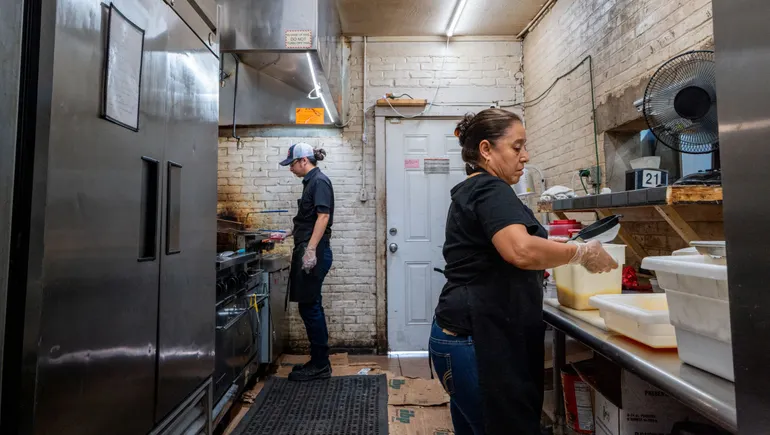
Week in review: HR’s uphill battle for employee trust
Rounding up top stories, including steps recruiters can take to ensure sourcing efforts don’t get lost in a sea of scams.

Thinking about cutting worker benefits to save money? Not so fast, expert warns.
“Maybe the juice isn’t worth the squeeze,” a senior consultant and actuary at Mercer said.
Facing a People Challenge?
Whether you are hiring, trying to retain a key employee, preparing for growth, or navigating a difficult decision, Bluewater Search Group can help you move forward with clarity and confidence.
Let's Talk